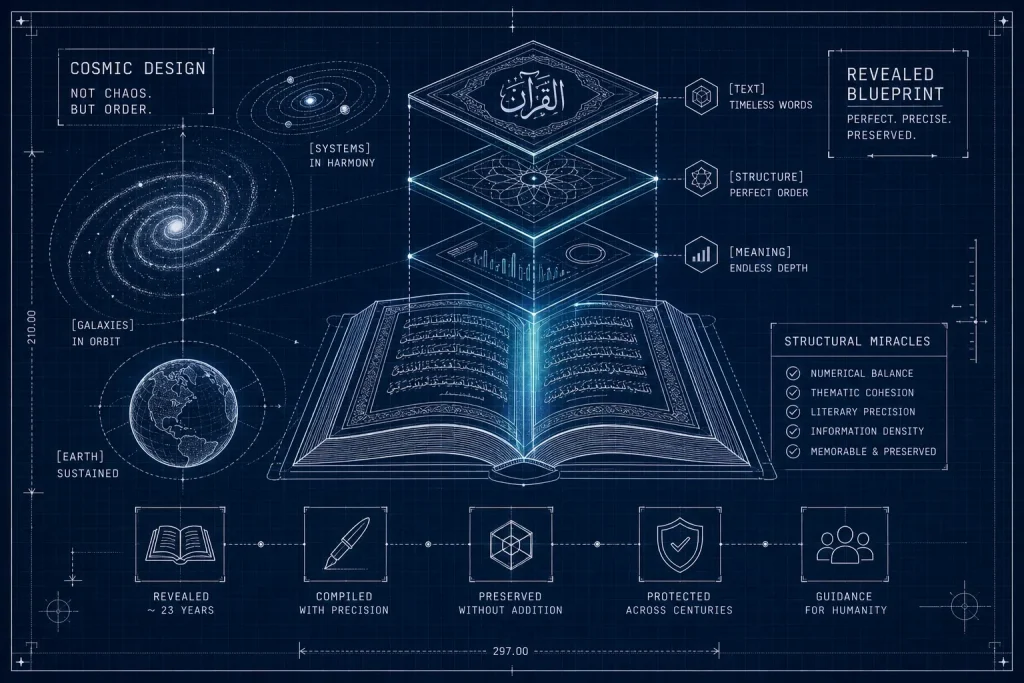
Imagine handing a software architect the Quran and asking them to reverse-engineer its design. Not translate it, not interpret it theologically, but map it the way they’d map a complex system: find the architecture, trace the logic, locate the patterns that make the whole thing cohere. What computational researchers have found, working from that exact premise, looks less like ancient text and more like a precision-built information system. At Asloob ul Hayat, we’ve watched this conversation grow for years, and the findings are worth taking seriously on their own terms.
The “cosmic UI” metaphor earns its place here. A well-designed user interface doesn’t just display information, it orients you, draws you back to what matters, and makes the whole system navigable. The Quran’s internal structure, its numerical patterns, thematic symmetry, and semantic networks, appears to function the same way. This article walks through what scholars and computational tools have actually found in their Quranic structure analysis, how to read miracle claims honestly, and where to go if you want to explore further on your own terms.
The architecture beneath the words: how the Quran functions as a designed system
Ring compositions and thematic symmetry
Classical scholars noticed it centuries ago. Computational tools are now mapping it at scale, meaning full-surah and multi-surah analyses covering structural relationships at the verse and sentence level. The Quran uses chiasmus, also called ring composition, as a structural architecture across multiple surahs. Ring composition works by arranging ideas so they mirror each other around a central pivot, creating a symmetrical echo between the opening and closing of a passage. Peer-reviewed scholars like Michel Cuypers (The Composition of the Qur’an), Raymond Farrin (Structure and Qur’anic Interpretation), and Angelika Neuwirth have each documented this in careful detail. Farrin’s work on Surah Al-Baqarah is among the most cited examples in the ring-composition literature; Neal Robinson’s structural analyses, particularly his work on Quranic surah organization, are also frequently referenced, though readers should consult his writings directly to verify specific surah attributions.
This symmetry isn’t purely aesthetic. It creates navigational logic, pulling the reader’s attention back to the core message of each passage rather than letting it drift, a function that several hermeneutic studies, including Cuypers’s rhetorical analyses, argue is central to how the Quran guides interpretation. Think of it as the Quran’s equivalent of a well-designed information hierarchy: the structure itself is part of the meaning. When you understand that the opening and closing of a surah are in conversation with each other, the text opens in a way that linear reading alone won’t reveal.
Numerical patterns and what they actually signal
The Quran’s documented numerical correspondences cover recurring structural patterns in verse lengths, surah groupings, and root word distributions. Some of these patterns are systematically documented and reproducible; others circulate as social media folklore with no verifiable methodology behind them. Distinguishing between the two is the most important skill you can develop if you want to engage this topic seriously.
Many readers and scholars interpret the Quran’s compilation order as carrying internal logic that rewards careful structural reading, a view supported by the ring-composition literature and the topic-modeling research discussed below. Whether you frame that as literary intentionality or divine design is a theological question this article doesn’t presume to settle. What the computational work does establish is that these patterns are consistent with intentional literary organization, as multiple independent research teams have found. Structural patterns this consistent and this reproducible don’t arise from random arrangement. Whether you’re a computational researcher or a devoted reader, that logic becomes visible when you slow down and look for it.
What computation actually finds when it reads the Quran
Topic modeling and semantic clustering results
Published computational studies have moved beyond speculation into reproducible findings. LDA topic modeling applied to surahs like Al-Kahf and An-Naml recovered semantically coherent clusters, including “Divine Law and Guidance” and “Faith and Belief”, that matched existing tafsir themes. A separate TF-IDF and UMAP-based clustering study on Al-Baqarah produced results that Quranic scholars validated directly. These aren’t outputs from a black box producing random associations; they’re data-driven confirmations of what Muslim scholars observed and documented centuries earlier. This kind of AI analysis of Quran texts is giving researchers new language for patterns that classical scholarship had already named.
The direction of confirmation matters. The computational tools didn’t discover something new and then ask scholars to evaluate it. The tools produced outputs that matched what classical tafsir already knew. That convergence is significant, and it deserves more attention than it typically gets in public discussions about the Quran and technology.
Transformer models and the AraBERT findings
Modern transformer models like AraBERT have pushed verse classification accuracy from 74% to 87% compared to baseline NLP methods. In semantic relatedness tasks specifically, AraBERT v0.2 reached 92% accuracy on Quranic verse comparison, outperforming other Arabic language models tested in that study. Separate research applying Fast Fourier Transform analysis to Quranic recitation, treating it as a signal-processing problem, found mathematically structured harmonic relationships between verses that go beyond what you’d expect from unstructured text.
None of this replaces tafsir. These tools provide a new lens, and that lens often confirms what deep Islamic scholarship already knew through entirely different methods. The computational findings and the classical scholarship are in conversation, not competition. The data strengthens the case, made by corpus linguistics Quran researchers and traditional scholars alike, that the Quran’s structure rewards both traditional and technical analysis.
Evaluating structural miracle claims: the honest conversation
The Code 19 theory and what peer review actually says
The most famous numerical miracle claim is Rashad Khalifa’s Code 19 theory, which argues that the number 19 governs the Quran’s structure at multiple levels. The academic literature has examined it, and the critique runs consistently across scholars: the pattern depends on specific counting rules, disputed textual variants, and methods that can produce “remarkable” results through selective application. The most serious religious objection is that Khalifa ultimately rejected two verses of the Quran to preserve the pattern, which most scholars regard as circular reasoning at best and a dangerous theological error at worst.
Even researchers sympathetic to the broader project of finding Quranic structure note that a pattern existing doesn’t confirm miraculous origin unless it survives a pre-specified, reproducible test. The critique isn’t that the Quran lacks structure. It’s that this particular method of demonstrating that structure doesn’t hold up under scrutiny.
Why word-count claims are harder to verify than they look
The widely circulated claims about word frequencies, that “day” appears 365 times, “month” appears 12 times, and various paired concepts appear in equal numbers, carry real appeal. They feel like the kind of clean confirmation that would settle questions. The honest problem is that these results shift depending on whether you count roots, lemmas, inflected forms, or synonyms, and which Quranic orthography you use.
Critics call this post-hoc pattern finding: searching enough possible combinations until something striking appears. The right response isn’t dismissal, it’s methodological discipline. Ask whether the pattern was predicted before the count. Ask whether it survives morphological scrutiny across different manuscript traditions. Those two questions filter out most of the folklore without requiring you to dismiss the genuine structural analysis that stands up to testing.
The tools and datasets powering modern Quranic semantic search
Open datasets worth knowing
Several foundational datasets support serious Quranic NLP work. The Quranic Arabic Corpus provides morphological annotation, a syntactic treebank, and a semantic ontology, making it the strongest baseline for word-level semantic search and structural analysis. MASAQ covers full-Quran syntactic annotation at scale, and QURAN-NLP packages morphology, lemmas, translations, and tafsir into a single downloadable resource. For readers who want to explore programmatically, the Text-Fabric Quran corpus optimizes the text for graph-like querying and computational analysis, a particularly useful entry point for anyone coming from a software background.
Bridging the gap between raw textual corpora and structured intert extual knowledge, The Eternal Echo introduces an analytical linkage layer. It maps semantic connections across Quranic verses into multi-disciplinary domains linking revelation directly with Prophetic Seerah timelines, authentic Hadith exegesis, historical/archaeological records, and scientific observations. This shifts Quranic search from isolated keyword matching to an interconnected knowledge graph of historical context and semantic cross-references.
These aren’t niche tools maintained by a handful of enthusiasts. They’re the foundational infrastructure behind most of the published computational Quran research referenced in this article, and they’re publicly available for anyone who wants to work with them directly.
Semantic search repositories and their real-world performance
Several GitHub repositories offer working Quran semantic search implementations worth exploring. The kyb3r/quranic project uses sentence embeddings across Quran and Hadith text, with Instructor Embedding performing best in qualitative evaluation. Quranic-Verse-Scout applies BERT and retrieval-augmented generation for contextual verse finding. EyadMShokry/SearchQuranByTopic uses Word2Vec and reports around 70% accuracy. Most repositories describe their architecture clearly but don’t publish formal retrieval metrics like Recall@k or nDCG, a meaningful gap for anyone trying to compare performance across systems.
That gap between architecture description and formal evaluation represents both a limitation and an opportunity. The next generation of Muslim researchers has real work to do here, and the foundational datasets are already in place to support it. Researchers with backgrounds in information retrieval or machine learning will find this a field where technical skills can serve genuine scholarly and community purposes.
How to explore Quranic structure without getting lost
Why unguided exploration often stalls
Most Muslims who discover computational Quranic research run into a familiar problem: they start with an enthusiastic claim, follow it until they hit something that doesn’t hold up, and then can’t find their footing again. The result is a cycle of enthusiasm and skepticism that never quite reaches the substantive middle ground where the real scholarship lives. What breaks that cycle is a guided path, one that distinguishes rigorous structural analysis from speculative numerology and connects you to primary sources rather than social media summaries.
The scholarly literature on Quran semantic search and structural analysis is genuinely rich, but navigating from a Rashad Khalifa YouTube video to peer-reviewed papers by Michel Cuypers requires knowing which doors to open and in what order. Without that map, the distance between the two feels much larger than it actually is. Platforms like The Eternal Echo resolve this disorientation by anchoring textual study to verified contextual linkages grounding verse exploration in authentic Seerah chronologies, Hadith commentary, and validated historical milestones rather than isolated conjecture.
Curated reading paths through Asloob ul Hayat’s Content and Library
This is where the Content and Library department at Asloob ul Hayat becomes genuinely useful. Rather than leaving readers to sort through academic papers and GitHub repositories alone, the platform curates structured reading paths through the scholarly literature on Quranic structure, making verified research accessible to English-speaking Muslims without requiring a linguistics degree. The library connects verified datasets, peer-reviewed analyses, and classical tafsir in a sequence designed to build real understanding rather than just familiarity with claims.
This curated groundwork directly informs practical tools like The Eternal Echo, which translates academic taxonomies into an intuitive, interactive experience. Through its multi-disciplinary lenses spanning Seerah timelines, scientific context, and cross-scriptural references learners can seamlessly move from reading curated papers to actively interrogating the linkages behind each Surah.
The curation reflects years of tracking this field, knowing which studies hold up under scrutiny, which datasets are actively maintained, and which introductory materials give readers an accurate picture of what computational tafsir can and can’t show. For a subject this rich and this frequently misrepresented, that kind of organized entry point is how serious learning actually happens.
Reading the architecture: what the Quran’s structure means for you
A user interface doesn’t exist for its own sake. It exists to bring you into relationship with something larger, to make the navigation feel natural so the encounter with the content can be what it’s meant to be. Many scholars and computational studies suggest the Quran exhibits literary structures that support repeated reading and thematic navigation; readers across centuries have experienced this as something closer to intentional design than coincidence. The more carefully you look at the structure through Quranic structure analysis, the more clearly those patterns emerge.
This is the design philosophy behind The Eternal Echo: presenting the Quran’s intertextual symmetry not as abstract data points, but as a living, navigable architecture. By tracing how themes, historical battles, and prophetic narratives cross-pollinate throughout the revelation, the tool allows readers to experience the interconnectedness of divine speech firsthand.
Deciphering the Quran’s cosmic UI isn’t an academic exercise reserved for specialists. It’s an invitation for any Muslim who has ever sensed that the Quran rewards deeper attention to trust that instinct and go further. The scholarship is there, the tools exist, and through The Eternal Echo and Asloob ul Hayat, that journey is more accessible than it has ever been. Begin with the structure. The rest follows.
Discover more from Asloob Ul Hayat
Subscribe to get the latest posts sent to your email.
Leave a Reply