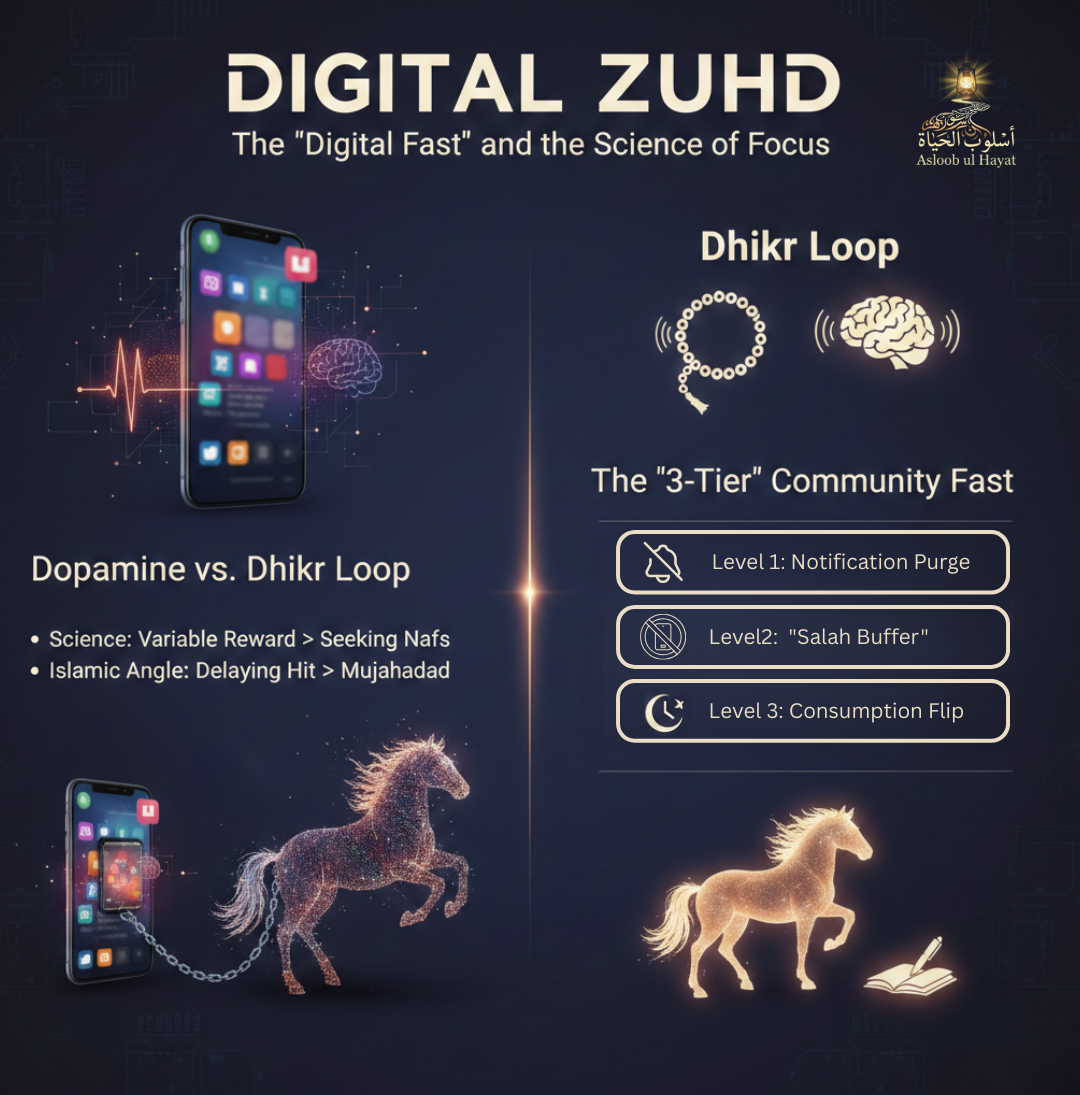

In 2026, we’ve moved past simple “time management.” We are now in the era of Attention Architecture. Research shows that constant notifications create a state of “Reactive Attention,” where your brain’s prefrontal cortex (the seat of willpower and deep reflection) is essentially hijacked by the more primitive parts of your brain.
1. The Level 1 Hack: Killing the “Cocktail Party Effect”
The Cocktail Party Effect is your brain’s ability to tune out background noise but snap instantly to a stimulus (like your name being called). Apps are designed to mimic this.
- The Science: Every time a non-human notification pings, your brain performs a “context switch.” Even if you don’t open the app, your cognitive load increases by roughly 37%.
- How it helps the Mumin: By turning off notifications between Asr and Maghrib, you aren’t just “saving time”—you are allowing your nervous system to exit “High-Alert Mode” and enter a state of calm (Sakinah) necessary for meaningful Dhikr or reflection.
2. The Level 2 Strategy: Beating “Resumption Lag”
When you switch from scrolling (passive) to studying a Surah (active), your brain experiences Resumption Lag—the time it takes to regain full focus after an interruption.
- The Science: It can take up to 23 minutes to fully recover your focus after checking a single notification.
- How it helps the Muhsin: Instead of just “reading,” try Active Retrieval. During your one hour of learning, close the book/video every 15 minutes and write down three things you just learned from memory. This forces the brain to “wire” the information into long-term memory rather than just letting it wash over you like a TikTok feed.
3. The Level 3 Goal: Resetting the Dopamine Baseline
The “addictive” apps you use are essentially digital slot machines. They keep your Dopamine Baseline artificially high.
- The Science: When you delete these apps for 10 nights, you aren’t just “missing out”; you are undergoing a Neurochemical Reset. By day 3 or 4, your brain becomes more sensitive to “low-stimulation” rewards—like the quiet peace of Tahajjud or the subtle beauty of a Quranic linguistic miracle.
- How it helps the Zahid: By removing the “High-Dopamine” source, you make the “Low-Dopamine” (but High-Value) act of Ibadah feel physically and mentally more rewarding.
Comparison Table: Digital vs. Deep Attention
| Feature | Digital Scrolling (Passive) | Active Learning (Deep) |
| Brain Region | Amygdala (Reactive) | Prefrontal Cortex (Reflective) |
| Chemical | Spikes of Dopamine (Fleeting) | Sustained Serotonin/Flow (Lasting) |
| Impact | Fragmented focus / Anxiety | Pattern recognition / Wisdom |
🌙 The 10-Night “Zahid” Replacement Plan
The goal is to move from “Digital Distraction” to “Divine Proximity.”
| Night | The “App Trigger” (When you’d usually scroll) | The Zahid Replacement (The “Deep Work”) |
| 21 | The “First Night” FOMO | Audit the Heart: Write down 3 specific habits you want to leave in the “Deleted App” and 3 you want to carry past Eid. |
| 22 | Browsing for news/trends | The Names of Allah: Pick 5 Asma al-Husna. Research their linguistic roots and how they manifest in your life right now. |
| 23 | Seeking “Short-form” entertainment | The Long Game: Start a deep-dive of one long Surah (e.g., Al-Kahf or Yusuf). Read the Tafsir of just 10 Ayats. |
| 24 | Comparison/Social Validation | The Secret Charity: Do a hidden act of kindness or a small anonymous donation. Reflect on the feeling of a “private” good deed. |
| 25 | Infinite Scrolling | Munaajaat (Intimate Conversation): Spend 20 minutes talking to Allah in your own language, out loud, about your specific fears and hopes. |
| 26 | Nightly “Doom-scrolling” | Prophetic Biographies: Read about a specific trial the Prophet (ﷺ) faced. Map his reaction to a current stressor in your life. |
| 27 | Laylatul Qadr Search | The Quranic Core: Spend this night cycling between Salah, Dua, and Istighfar. No screens, just the Mushaf and your prayer mat. |
| 28 | Checking notifications | Tadabbur (Deep Reflection): Pick one Ayat that moved you this month. Sit in silence for 15 minutes asking why it moved you. |
| 29 | Pre-Eid distractions | The Gratitude Audit: Write a physical letter (pen and paper) to someone who helped your Deen this year. |
| 30 | Final Night “Relapse” | The Preservation Plan: Write down exactly how you will re-install (or keep deleted) your apps on Eid morning. |
Export to Sheets
🛠️ Your “Zahid” Toolkit
1. The 5-Minute “Urge” Rule
When the muscle memory kicks in and your thumb reaches for the spot where the app used to be:
- The Science: A craving usually lasts about 3 to 5 minutes.
- The Action: Perform Wudu or stand up and do 10 repetitions of SubhanAllah, Alhamdulillah, Allahu Akbar. By the time you’re done, the neurochemical “itch” will have subsided.
2. The “Analog” Buffer
Keep a physical notebook and a Quran next to your bed or prayer spot. If your brain feels “bored,” your hands have a physical object to reach for that isn’t a glass screen.
3. Replace the “Like” with a “Dua”
Every time you feel the urge to see if someone “liked” a post, make a specific Dua for that person instead. It flips the dopamine-seeking (taking) into a spiritual gift (giving).
The “Tadabbur” over “Quantity” Rule
Instead of just racing to finish the Quran, suggest they pick one Surah they struggle with or find beautiful and deep-dive into its meaning. This builds a lasting connection, not just a temporary habit.
1. The “Power Nap” Protocol
To survive the late nights:
-
Qailulah: A 20-minute nap before Dhuhr.
-
Post-Asr Rest: Avoid heavy work to save energy for Iftar and Qiyam.
2. The Ultimate Dua List (The 3×3 Method)
Ask them to write down:
-
3 Things for the Akhirah (Jannah, forgiveness, protection from Fire).
-
3 Things for this World (Career, family, health).
-
3 Things for the Ummah (Palestine, the oppressed, the community).
Digital Zuhd isn’t just about emptying your mind of distractions; it’s about filling it with what matters. Once you’ve cleared the digital noise, use that space to memorize the authentic Duas of the Quran to anchor your heart in tranquility.
Discover more from Asloob Ul Hayat
Subscribe to get the latest posts sent to your email.