
The Prophetic Blueprint: Leadership Principles and Personal Effectiveness from the Daily Routine of Muhammad ﷺ
Introduction: A Framework for Holistic Leadership
Great leaders across history are often defined by the disciplined architecture of their daily lives, from Marcus Aurelius to Benjamin Franklin. The life of the Prophet Muhammad ﷺ, meticulously documented by his companions, offers a uniquely holistic case study in how purpose-driven routines can amplify influence and foster a resilient community. This brief analyzes his daily life not as a mere historical account, but as a source of actionable principles for contemporary leaders. The purpose is to deconstruct his daily schedule, leadership philosophy, and personal habits to build a holistic model for personal effectiveness, community engagement, and moral character. This analysis will explore how these ancient routines provide a timeless framework for navigating modern challenges, offering a blueprint for leadership that is both strategic and deeply human.
1. The Architecture of a Purpose-Driven Day: Time Management and Strategic Scheduling
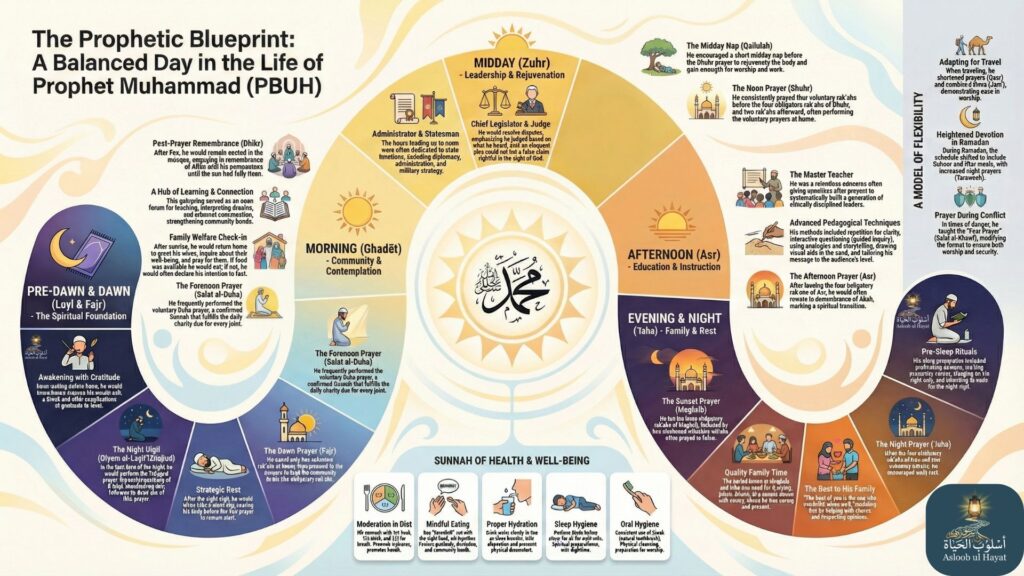
The strategic importance of a structured daily routine is a cornerstone of effective leadership, providing the scaffolding upon which focus and productivity are built. The Prophet Muhammad’s ﷺ schedule demonstrates a sophisticated understanding of this principle. This section deconstructs his daily schedule, not as a rigid timetable, but as a dynamic framework built on core principles of focus, balance, and strategic energy management.
1.1 Pre-Dawn Excellence: The Power of Tahajjud and Fajr in Personal Effectiveness
The five daily prayers Fajr (dawn), Dhuhr (midday), Asr (afternoon), Maghrib (sunset), and Isha (night) functioned as the structural pillars of the Prophet’s ﷺ day. These were not mere interruptions but deliberate pauses that demarcated time, created a rhythm for work and rest, and provided regular opportunities for spiritual and mental re-centering. His day was organized around these fixed points: community gatherings took place after Fajr, his main meal was typically after Maghrib, and his night began after Isha. This prayer-centric structure was a profound source of renewal, allowing him to transition between responsibilities with clarity and purpose. His longing for it was captured in his famous words, “Prayer is the apple of my eye.” For a contemporary leader, this illustrates the power of “rhythmic discipline” integrating non-negotiable, short breaks for reflection that punctuate the day, preventing burnout and ensuring strategic alignment.
1.2 The “Important & Not Urgent” Quadrant in Practice
The period between the Maghrib (sunset) and Isha (night) prayers offers a compelling case study in strategic prioritization. During this time, the Prophet ﷺ would engage in a variety of activities, including offering voluntary prayers at home, participating in learning circles, and feeding the poor. Using the terminology of the “Time Management Matrix,” these actions fall squarely into the “Important & Not Urgent” quadrant.
This quadrant, which management sources identify as the key differentiator between “successful and unsuccessful people,” is dedicated to activities that build long-term value, such as planning, relationship building, and personal development. By consistently dedicating this time to family education, community knowledge-building, and public service, the Prophet ﷺ was investing in the foundational health of his community and developing his own self-leadership. This stands in contrast to the alternatives often found in modern schedules for this time of day, such as practicing sport, fulfilling personal desires, or pursuing additional work for material reward.
1.3 Strategic Rest: The Biphasic Sleep Model and the Midday Nap
The Prophet’s ﷺ sleep routine was a sophisticated strategy for managing energy and enhancing cognitive performance. He practiced a segmented, or biphasic, sleep pattern: sleeping in the first part of the night, waking after midnight for a period of extended night worship (Tahajjud), and then taking another short nap before the Fajr prayer.
In addition to this, he consistently practiced a midday nap known as qaylulah. This routine was designed to maintain stamina for his demanding daytime responsibilities and his rigorous late-night spiritual disciplines. He actively encouraged this practice, stating, “Take a nap at midday, for the satan does not take a nap at midday.” This combination of segmented night sleep and a midday siesta provided a powerful mechanism for physical and mental restoration, a practice modern sleep science is increasingly validating for its benefits on productivity and well-being, demonstrating an ancient alignment of spiritual discipline with peak cognitive performance.
2. The Core Tenets of Servant Leadership: Influence Through Humility and Integrity
The Prophet Muhammad’s ﷺ daily actions were not a random collection of good deeds; they were the consistent expression of a coherent and powerful leadership philosophy. His influence was built not on authority or coercion, but on a foundation of service, radical accessibility, and unwavering ethical conduct. This section analyzes the core tenets of that philosophy, demonstrating how he prioritized the needs of his community to build a culture of deep trust and loyalty.
2.1 Leading with Humility and Radical Accessibility
The Prophet’s ﷺ public conduct was a masterclass in approachable and humble leadership. He actively dismantled the barriers that typically separate leaders from their people, fostering a culture of trust and psychological safety.
• No Special Status: In his gatherings, he had no designated seat or distinguishing sign. Strangers arriving would have to ask, “Who among you is Muhammad?” It was only towards the end of his blessed life, in what became known as “the year of delegations,” that his companions persuaded him to accept a slightly raised bench of mud so that a stranger coming in would know him.
• One of the People: He would sit with his companions as one of them. He used to divide his smiles and attention so equally among them that when they dispersed, each one would think that he was the Prophet’s ﷺ favorite companion.
• Available to All: He was accessible to every member of society. He would stop for anyone who wished to speak with him, whether it was a prominent companion or a “maid or a woman” with a simple need.
• Proactive Engagement: Rather than expecting people to come to him, he practiced a form of proactive stakeholder engagement. He visited the sick, checked on the welfare of people in their marketplaces, and personally attended to the needs of the weak and poor.
These consistent practices demonstrated a genuine concern for the well-being of his followers, making his leadership profoundly influential and deeply personal.
2.2 The Triad of Influence: Mercy, Justice, and Kindness
His leadership was established on three interconnected foundations: mercy, justice, and kindness. These were not abstract ideals but were demonstrated through his daily interactions and critical decisions.
• Mercy: During the Battle of Uḥud, after being physically wounded by the opposing army, he was seen wiping blood from his face while praying, “O Allah, forgive my people, for they do not know.” His capacity for mercy transcended personal injury and immediate circumstance.
• Gentleness: When a group of Jews greeted him with the mocking phrase, “death be upon you,” his wife `Aishah responded angrily. The Prophet ﷺ calmly corrected her, saying, “O ‘Āishah, be gentle! Allah is Gentle and loves gentleness in all matters, so beware of harshness and vulgarity.”
• Kindness: His kindness was grounded in intimate, personal conduct. His wife `Aishah narrated that when they shared a cup, he “would then take it and drink placing his mouth where I had placed my mouth on the cup.”
2.3 Stewardship and Unwavering Integrity
The Prophet ﷺ viewed leadership as a profound trust and operated with an unwavering commitment to accountability and ethical principles. He taught that a leader is a steward responsible for their people, stating that any ruler who is not honest in looking after them “will never feel even the smell of Paradise.”
This integrity was codified in his famous title, al-Amīn (the Trustworthy), a name given to him by his community long before his prophethood. Even his most ardent enemies entrusted their valuables to him for safekeeping. This commitment to one’s word was absolute. When his companion Ḥudhayfah was released by an enemy force on the condition that he not fight against them, the Prophet ﷺ honored that promise. Despite being in a vulnerable military position and in need of every soldier, he instructed Ḥudhayfah to stand down, stating, “We will keep our promise to them, and we will seek aid from Allah against them.”
3. Cultivating Personal Mastery: The Habits of an Effective Leader
A leader’s public influence is inevitably anchored in their private discipline. The Prophet’s ﷺ effectiveness was not accidental; it was the result of an intentional and disciplined personal life. The habits he cultivated simplicity, work-life integration, and spiritual resilience formed the bedrock of his character and provided the inner strength required to lead his community through immense challenges.
3.1 The Discipline of Simplicity
The Prophet ﷺ deliberately maintained a simple and austere lifestyle, a practice that minimized distractions and kept his focus squarely on his mission and community.
1. Food: He never criticized food. He ate whatever was available, and there were times when his household subsisted on only dates and water for months. He always ate on the floor, never at a table.
2. Possessions: His bed was a simple mattress made of hide filled with palm fiber, which often left marks on his skin as he slept.
This simplicity was a conscious choice. By finding contentment in the bare essentials, he cultivated a state of mental freedom and focus, unburdened by the pursuit of material comfort or the anxieties of possession.
3.2 Work-Life Integration: Family and Community
The Prophet ﷺ rejected a sharp division between his public and private spheres, seamlessly integrating his familial duties with his leadership role. His wife `Aishah famously described his approach: “He would serve his family, then when the time for prayer came, he would go out to the prayer.”
This integration was a daily practice. After the dawn prayer, he would make a round to visit all of his wives. After the afternoon prayer, he would spend quality time with his entire family. His interactions were marked by affection and presence; for example, he would intentionally eat from the same spot on a utensil or drink from the same place on a cup as his wife. This model presents a holistic vision of leadership where family is not a competing priority but an integral part of a leader’s life, responsibilities, and source of strength.
3.3 The Inner Life: Forging Spiritual Resilience
At the core of his personal mastery was a set of consistent spiritual practices that forged immense inner strength, clarity of purpose, and humility.
• Night Prayer (Tahajjud): His night worship was described as a “profound spiritual experience.” He would immerse himself completely, and when he came across verses about mercy, he would pause to ask for mercy; when he read verses about punishment, he would seek refuge.
• Constant Remembrance (Dhikr): His awareness of God was continuous. He was “always mentioning God and glorifying Him,” from the moment he woke until the moment he slept.
• Seeking Forgiveness: Despite being a prophet assured of divine forgiveness, he constantly sought it. His companions reported counting him saying “My Lord, forgive me and accept my repentance” more than 100 times in a single gathering.
These were not mere rituals but core disciplines for building the mental fortitude, clarity of purpose, and humility necessary to bear the immense weight of his mission without succumbing to arrogance or despair.
Conclusion: Implementing the Blueprint in the 21st Century
The daily life of the Prophet Muhammad ﷺ presents a holistic and deeply integrated model of leadership where disciplined time management enabled robust community engagement, a philosophy of servant leadership guided every interaction, and deep personal habits provided the resilience to sustain the mission. The principles that emerge structured flexibility, influence through humility, and the cultivation of personal mastery form a comprehensive blueprint. This prophetic model, therefore, is not a relic of history but a direct challenge to contemporary leadership paradigms. It asks leaders to measure their success not just by quarterly results, but by the integrity of their character, the accessibility of their presence, and the resilience forged in their private discipline. It offers a framework for building not just a successful career, but an enduring and honorable legacy.
Irteqa-e-Hayat Ramadan Planner
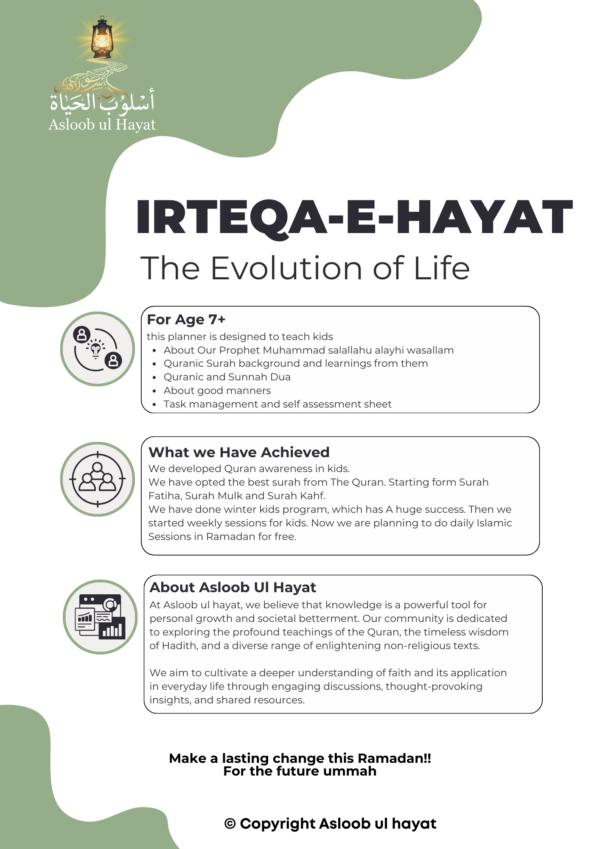
Irteqa-e-Hayat planner is designed to teach the fundamentals of Islam through engaging, interactive content. This resource serves as a roadmap for spiritual and personal development
Discover more from Asloob Ul Hayat
Subscribe to get the latest posts sent to your email.