


Do you know that there is a magazine in the world that publishes a new edition every year at the end of the year, and on its cover it makes many predictions about the coming year? And when the new year begins, the predictions they made turn out to be 100% true.
This Magazine is known as The Economist. But something you may not know is this: who owns The Economist?
The Economist is owned by the Rothschild family. In November 2025, The Economist released a new edition about 2026, and on its cover it made many predictions about what will happen in 2026.
Now, an important question arises:
What does The Economist see happening in 2026 that you and I may not know?
And the second question is: are the things that The Economist presents as predictions really just predictions, or are they part of a well-planned strategy?
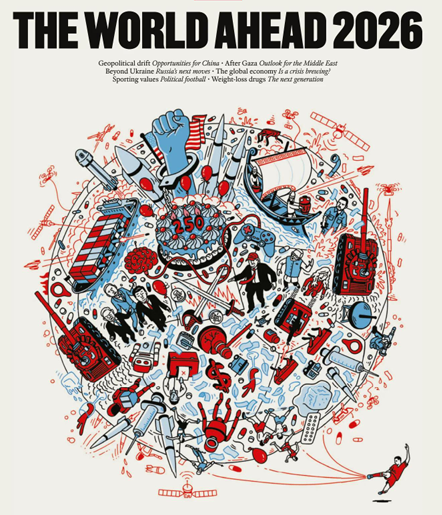
This is a cover image of “The world Ahead 2026” magazine. It shows missiles, tanks, warships, drones, satellites, syringes, pills, medical symbols, robots, AI, game controllers, and major world leaders. In the center, there is a cake with 250 written on it. Along with it, there is the American flag and two blue hands — one hand is locked in handcuffs. Outside, there is a footballer trying to kick the world.
If we decode these symbols, let us start with the cake. On 4 July 2026, America will complete 250 years. It will be the 250th anniversary of the Declaration of Independence. The handcuffs mean that if any movement rises inside America, it will be crushed. The heavy presence of drones and satellites suggests that in 2026 everything will be automated and controlled, and privacy will almost disappear.
The robot dog “Spot” from Boston Dynamics is also shown, which is used by the military and police. This indicates that robots will replace low-paid and odd jobs.
Missiles and war symbols mean that conflicts will continue:
the Ukraine war, the Gaza situation, increased military spending in Europe, unrest in Myanmar and Sudan, and rising tensions between the USA, China, and Russia. A major world war may not happen, but hybrid wars, cyberattacks, and proxy conflicts will continue.
Medical symbols indicate that GLP-1 weight loss drugs such as Ozempic, Wegovy, and Mounjaro will become cheaper and more accessible by 2026, leading to a new medical revolution.
The footballer officially represents the FIFA World Cup 2026, which will be hosted by the USA, Canada, and Mexico. Unofficially, it may also suggest that the people controlling the system are standing outside it — the game masters.
The final symbol is a falling graph, pointing toward a declining dollar value, a bond market crisis, and a growing debt crisis. In 2026, global debt may become unmanageable, markets may remain volatile, and even personal savings could be at risk.
However, the main purpose of writing this article is to discuss one prediction that already seems to be coming true at the start of 2026: massive weight loss transformation.
In the magazine, pages 95–97, under the title Science and Technology, GLP-1 drugs such as Ozempic, Wegovy, and Mounjaro are discussed. GLP-1 drugs are medications that mimic a natural hormone in the body to control blood sugar and reduce appetite. These drugs were originally developed to treat Type-2 diabetes, but their powerful side effect — weight loss — has made them popular for weight reduction as well.
How do GLP-1 agonists work?
They act like a hormone that controls both insulin and appetite.
➡️ Because of this hormone, a person feels less hungry and eats less, which leads to weight loss.
➡️ Popular drugs in this class include Ozempic, Wegovy, and Mounjaro/Zepbound.
Now, why did I say that this prediction already seems to be coming true?
Take a look at these pictures.

Doesn’t all this look like something that is happening very suddenly? A massive transformation in just six months. Weight drops from 95 kg to 65 kg through weight-loss injections. Everywhere you look, it’s Ozempic, Ozempic.
The cost of weight-loss injections is:
- ₹60,000 per month
- Special GLP-1 friendly food launched by Nestlé: ₹30,000 per month
- Total cost:₹90,000 per month
- Yearly cost: ₹10,80,000
- Lifetime cost:more than ₹1 crore
And along with this, there is a guarantee that weight will definitely go down.
The companies making these injections, Eli Lilly and Novo Nordisk, have crossed a market value of over 1 trillion dollars. The Economist says that by 2026, the focus will shift toward pill versions of these GLP-1 drugs. The magazine calls this a game-changer because pills are much easier to manufacture, transport, and store than injections that require cold storage. This will reduce prices and make the treatment available to millions more people, especially in middle-income countries.
The magazine also talks about a major social change. As these pills become as common as daily vitamins, the “Ozempic economy” will grow. The editor predicts that these drugs will not remain limited to treating diabetes or medical obesity; instead, they will be used by a much larger group of people who simply want to stay thin or manage their weight for lifestyle reasons.
After seeing all this, you might think: “If only I had this much money, I could also lose weight like this.”
But the issue here is not money. The real issue is haste — taking shortcuts that give temporary benefits but cause serious harm later, sometimes without you even realizing it.
Yes, these injections do work — there is no doubt about that. But do they guarantee your health? Do they guarantee lifetime weight loss? I don’t think so.
Novo Nordisk has earned so much money just by selling these injections that its value is now higher than the entire GDP of Denmark. When so much money is involved, can you really expect them to tell you the whole truth?
Let’s look at the side effects:
- Sudden blindness: In some cases, patients reported sudden loss of vision in one eye or blurred vision. In most cases, it is painless — there is no eye pain, but eyesight is lost.
- Gastroparesis (stomach paralysis): Some patients reported continuous vomiting and stomach paralysis even after stopping the drug. A study published in BMJ Open Gastroenterology (2025) found that people using semaglutide had a much higher risk of gastroparesis compared to other weight-loss treatments.
- Pancreatitis: Many users developed acute pancreatitis, a painful and potentially life-threatening inflammation of the pancreas.
- Pancreatic and kidney risks: In rare cases, serious pancreatic or kidney problems have been reported.
- Muscle loss: Rapid weight loss can also cause loss of muscle mass along with fat.
By January 2026, 2,190 people in American courts are fighting cases against Novo Nordisk and Eli Lilly.
- Some have become blind.
- Some have permanent stomach paralysis.
In the end, the discussion comes back toAsloob-ul-Hayat — a way of life. The methods that Allah has already shown us in the Quran, and that the Prophet ﷺ demonstrated through his life: waking up early, eating only when hungry, eating healthy food, and fasting in Ramadan so that we learn to control our desires.
When a person goes against nature, they are then forced to rely on shortcuts like GLP-1 drugs.
Discover more from Asloob Ul Hayat
Subscribe to get the latest posts sent to your email.