
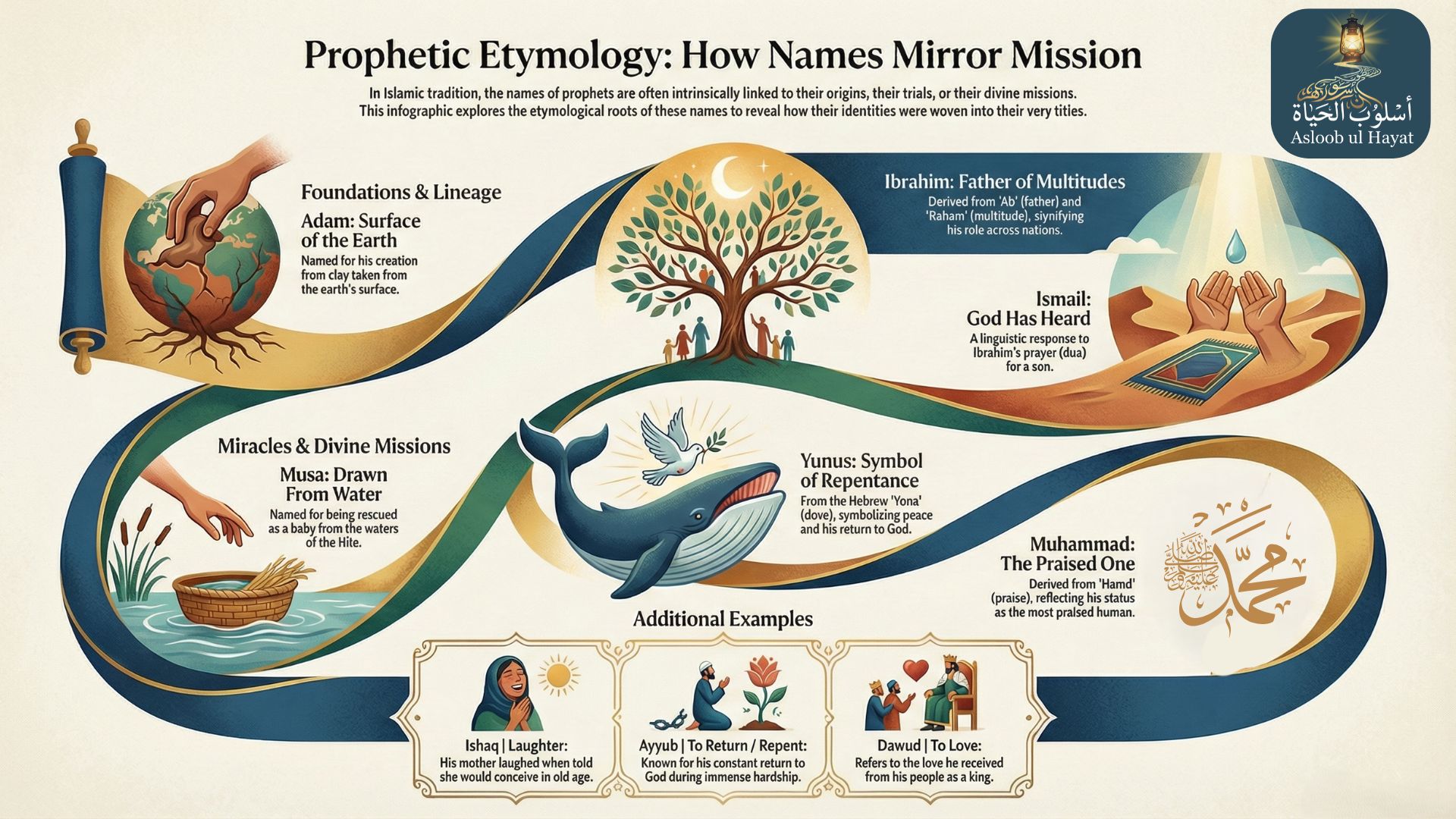
Have you ever stopped to think about how the names of the prophets perfectly match their life’s mission or their very identity? According to the sources, there is a fascinating connection between these names and the destinies of the men who bore them. Let’s dive into some incredible examples of how deeply a name can reflect a life’s purpose.
Adam: The First Human
The name Adam (آدم) is linked to the Arabic word أديم الأرض (adīm al-arḍ), meaning the “surface of the earth”. This is incredibly fitting, as he was the very first human being, created from طين (ṭīn) clay gathered directly from the earth’s surface.
Allah says in the Qur’an:
إِنِّي خَالِقٌ بَشَرًا مِّن طِينٍ
“Indeed, I am creating a human being from clay.” (Surah Sad 38:71)
As the first human being, his very name reflects his origin formed from the ground and given life by God. His story represents the beginning of human existence and the start of mankind’s moral journey.
Nuh (Noah): A Legacy of Sorrow
Nuh (نوح) comes from the root ن-و-ح (n-w-ḥ) which means to wail, lament, or cry intensely. His life was filled with hardship and sorrow.
فَلَبِثَ فِيهِمْ أَلْفَ سَنَةٍ إِلَّا خَمْسِينَ عَامًا
“He remained among them for a thousand years minus fifty years.” (29:14)
For 950 years, he called his people to righteousness, enduring rejection, ridicule, and disbelief. Despite the pain he faced, he remained steadfast. His name reflects both his emotional endurance and the gravity of the destruction that ultimately befell his people.
Hud and Saleh: The Guides and Reformers
The name Hud is associated with the root ه-د-ي (h-d-y) meaning to guide (هداية – hidāyah). which was precisely his mission when he was sent to the arrogant and immensely powerful people of Ād.
Saleh comes from the root ص-ل-ح (ṣ-l-ḥ) meaning to be righteous, to reform, or to correct. The word صلاح (ṣalāḥ) means “righteous,” “to fix,” or “to do good,”. He was sent to reform the people of Thamud, calling them back to justice and moral uprightness. Both prophets embodied the meanings of their names through their reformative missions.
Ibrahim and His Lineage
• Ibrahim (إبراهيم): Father of Many: Derived from the Hebrew Ab (أب / father) and Raham (رَهام / multitude), his name means “father of many,” which is why he is known as the father of many nations.
Allah says:
إِنِّي جَاعِلُكَ لِلنَّاسِ إِمَامًا
“Indeed, I will make you a leader for the people.” (Baqarah 2:124)
• Ismail: Combining سمع (samiʿa / to hear)and إيل (El) (God in Hebrew), this name means “God has heard.” It was a direct, literal response to Ibrahim’s heartfelt prayer for a son.
• Ishaq (إسحاق) means laughter. this name was a joyful play on words. His mother, at an advanced age, laughed in disbelief when angels gave her the glad tidings that she would bear a child.
The Qur’an describes the reaction of his mother:
فَضَحِكَتْ فَبَشَّرْنَاهَا بِإِسْحَاقَ
“So she laughed, and We gave her glad tidings of Ishaq.” (Surah Hud 11:71)
• Yaqub (يعقوب): Coming from a root word meaning “to follow, heal, or come after,” his name signifies his place in the prophetic lineage, coming after his predecessors.
• Yusuf (يوسف): This name means “to increase or to add.” His life story is a testament to this, characterized by a constant increase in patience, beauty, and authority on area.
Allah says:
إِنَّهُ مَن يَتَّقِ وَيَصْبِرْ فَإِنَّ اللَّهَ لَا يُضِيعُ أَجْرَ الْمُحْسِنِينَ
“Indeed, whoever fears Allah and is patient, then Allah does not allow the reward of the righteous to be lost.” (Surah Yusuf 12:90)
Musa (Moses): Drawn from the Water
The name Musa (موسى) can be linguistically divided into two parts that directly relate to water: “Moo” translates to water, and “S” means to draw out or take out from water. This literal meaning perfectly matches his life story, as Prophet Musa was famously taken out of the Nile River as a baby.
فَالْتَقَطَهُ آلُ فِرْعَوْنَ
“Then the family of Pharaoh picked him up.” (Surah Al-Qasas 28:8)
Ayyub: The Patient Penitent
Ayyub (أيوب) is linked to the root أ-و-ب (a-w-b) meaning to return. The word أواب (awwāb) means one who constantly returns to Allah. Ayyub means “to return or to repent.” He was highly regarded for his immense patience and his constant return to Allah throughout his severe hardships.
Despite immense suffering, he remained patient:
إِنَّا وَجَدْنَاهُ صَابِرًا ۚ نِّعْمَ الْعَبْدُ ۖ إِنَّهُ أَوَّابٌ
“Indeed, We found him patient. What an excellent servant. Indeed, he was one who constantly returned (to Allah).” (Surah Sad 38:44)
Dawud and Suleiman: The Kings of Love and Peace
• Dawud (David): Rooted in the word for “to love,” he was granted wisdom, power, and the love of his people, ruling as the first king prophet. Allah revealed divine scripture (Zabur – زبور)
• Suleiman (Solomon): From the root س-ل-م (s-l-m) meaning peace (سلام – salām) Coming from the root for “peace,” his reign was historically marked by peace and unity.
Yunus (Jonah) and Isa (Jesus)
• Yunus: Derived from the Hebrew Yona meaning “dove,” it stands as a symbol of peace and repentance. This echoes his story of being swallowed by a whale and subsequently repenting to Allah.
لَّا إِلَٰهَ إِلَّا أَنتَ سُبْحَانَكَ إِنِّي كُنتُ مِنَ الظَّالِمِينَ
“There is no deity except You; exalted are You. Indeed, I was among the wrongdoers.” (Surah Al-Anbya 21:87)
• Isa: Meaning “God saves or deliverer.” In Islamic belief, Isa was not crucified; rather, he was raised up, and Allah saved him.
بَل رَّفَعَهُ اللَّهُ إِلَيْهِ
“Rather, Allah raised him to Himself.” (Surah Nisa 4:158)
Muhammad: The Most Praised
Muhammad (محمد) comes from the root ح-م-د (ḥ-m-d) meaning to praise. It means the one who is frequently praised. Related names include:
- أحمد (Ahmad) – more praised
- حامد (Hāmid) – one who praises
- محمود (Maḥmūd) – the praised one
Allah says:
وَرَفَعْنَا لَكَ ذِكْرَكَ
“And We raised high for you your mention.” (Surah Ash-Sharh 94:4)
Finally, the name Muhammad comes from hamd, which means “to praise” or “the one who is praised”. True to his name, he remains the most praised and remembered human being in history, with billions sending blessings upon him daily. His life represents the completion of the prophetic mission and the embodiment of mercy to mankind.
Conclusion
The names of the prophets from آدم to محمد are not mere identifiers. They reflect origin, mission, character, and destiny. Each name carries linguistic depth and spiritual symbolism, enriching our understanding of their lives and their divine roles in guiding humanity.
Discover more from Asloob Ul Hayat
Subscribe to get the latest posts sent to your email.